GAP(S)
(3/100) fruitful void / violent absence
Dear friends & witnesses,
I’ve been thinking about GAPS (different ones). Since my last post over a year ago, I am also still thinking about mirrors, though I don’t have much to add, because most of my attention in the past year has been on a new role. Still, I’ve had some moments to reactivate the body x data research, so read on for some updates and new art…

…though the reflection I’d like to offer here is that it is not in spite of slowness that my independent art/research thrives for decades, but because of it. I only work on these projects in the interstitial spaces of my life, a few hours a week or not at all, allowing projects to take their time, take months and years, and only be those parts that are most essential. Most of the work has been to, literally, sleep on ideas, let them digest, not write them down, but instead trust the worthwhile stuff to bubble up again and again, each time a better version of itself, polished not by an exertion of force but by the watery forces of my own incomprehensible interiority. Whatever else I am doing can also then refract and reverberate in my art! Anyway, so the new art I have to share is from a 25-year old memory, which was only now ready to be revisited. So: the new art I have to share is, arguably, the least “new” art I could possibly be sharing. The GAP - of time, of activity - is in this case a powerful creative force.
In the past year+, I haven’t had headspace to host any workshops related to the body x data research, but others have; and I’m rehydrating my sporadic performance practice. I’ve also significantly deepened the practice-based research around sleep and seasons this summer, spending several weeks in the Arctic circle for a second time (I have not yet integrated this through art, but I can feel the process underway). Over the summer, some the participants of my past workshops graciously included me in their organization of a “Bring Your Own Biodata” workshop at a design conference. In September, artist Elly Clarke held another exhibition and performance of #Sergina’s DESPERATELY DELICIOUS DIRTY DATA DELIVERY, which included our collaborative work (since 2019). I was sad to miss these events, but I did take the train over to Frankfurt’s NODE + CODE where I performed NO EXIT (a faithless recording below), and presented a lecture-performance.
NO EXIT implements in Python a pre-Y2K memory.
The 1998/9 intent was to force the user into a hard shutdown of their desktop
NO EXIT was first created in Delphi without knowing how to program. The current code does not achieve its goal, and the original code likely did not, either. The latter also no longer exists.
NO EXIT is a story
a rhetorical gesture
a fiction expressed as code
This is not about body data. But in the talk, I connected the body data research with my prior my PhD research on software engineering and code work, emphasizing that:
Critical reading skills are essential to an empowered civil society - reading of all kinds of text, including language, images, and code.
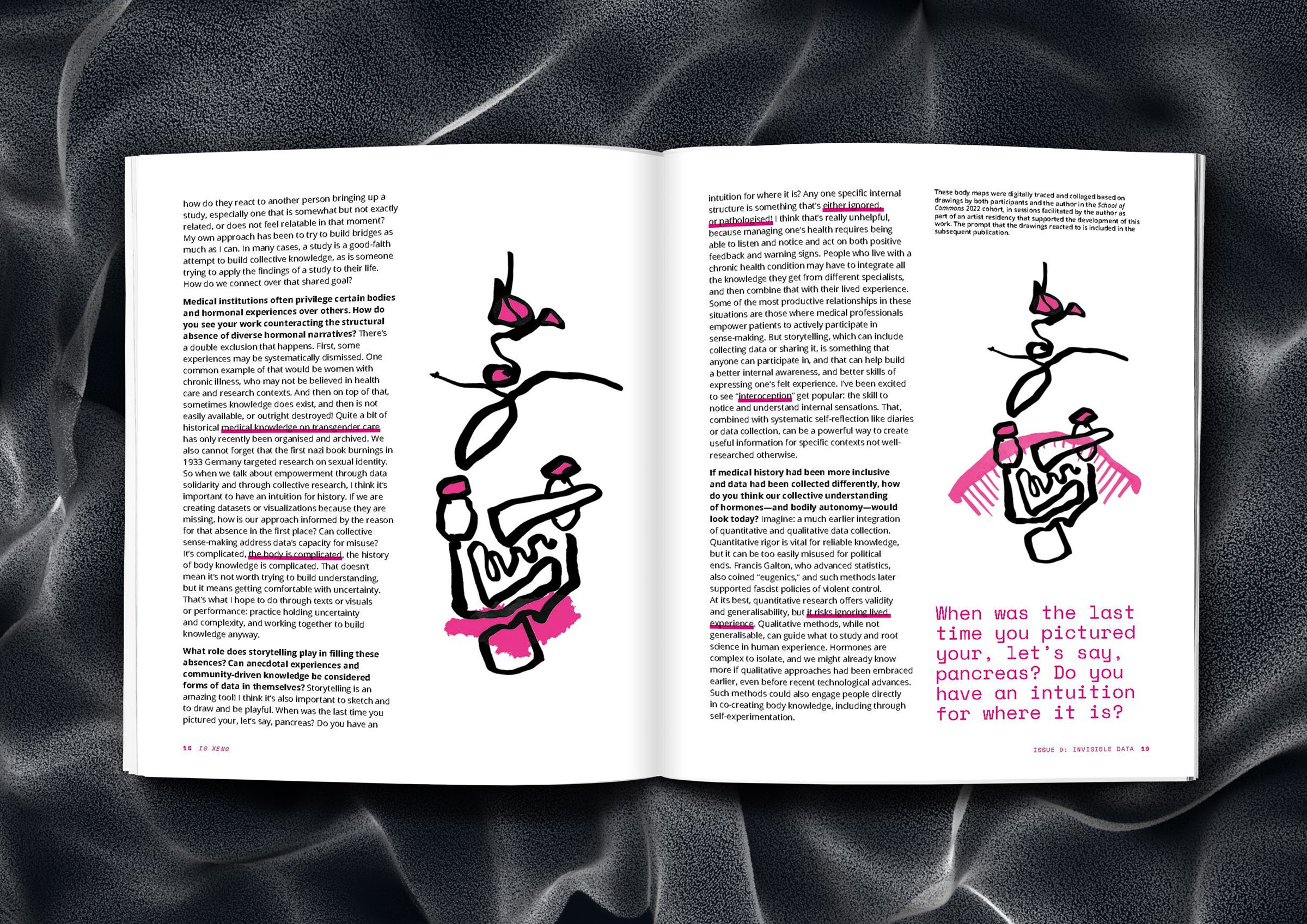
Technological, scientific, and data empowerment is the common motivation between what may look like different interests on my part. That brings me to the last news: an interview about my 2022+ hormones research is part of the upcoming Market Cafe Magazine Issue #9 on Invisible Data. Excerpting from that text (emphasis added):
Medical institutions often privilege certain bodies and hormonal experiences over others. How do you see your work counteracting the structural absence of diverse hormonal narratives?
There’s a double exclusion that happens. First, some experiences may be systematically dismissed. One common example of that would be women with chronic illness, who may not be believed in health care and research contexts. And then on top of that, sometimes knowledge does exist, and then is not easily available, or outright destroyed! Quite a bit of historical medical knowledge on transgender care has only recently been organised and archived. We also cannot forget that the first nazi book burnings in 1933 Germany targeted research on sexual identity. So when we talk about empowerment through data solidarity and through collective research, I think it’s important to have an intuition for history. If we are creating datasets or visualizations because they are missing, how is our approach informed by the reason for that absence in the first place? Can collective sense-making address data’s capacity for misuse? It’s complicated, the body is complicated, the history of body knowledge is complicated. That doesn’t mean it’s not worth trying to build understanding, but it means getting comfortable with uncertainty. That’s what I hope to do through texts or visuals or performance: practice holding uncertainty and complexity, and working together to build knowledge anyway.
…
If medical history had been more inclusive and data had been collected differently, how do you think our collective understanding of hormones—and bodily autonomy—would look today?
Imagine: a much earlier integration of quantitative and qualitative data collection and analysis methods. Quantitative rigor is important to building reliable knowledge, but it can be too easily misused for political ends. Francis Galton, an important figure in statistical methods development, also coined the term “eugenics.” Statistical methods were later used within the racial policies of fascist regimes to support extreme, violent control. What if quantitative methods never had their political potency? At its best, quantitative research offers validity and generalisability, but it risks ignoring lived experience. Qualitative methods, while not generalisable, can guide what to study and root science in human experience. Hormones are complex to isolate, and we might already know more if qualitative approaches had been embraced earlier, even before recent technological advances. Such methods could also engage people directly in co-creating body knowledge, including through self-experimentation.
Though I can turn the GAP in body knowledge relevant to my own lived experience into creative practice, these gaps are still violent absences. Some of the gaps have been bridged through even further violence (see: gynecological research in the US).
As a person with a body, I want understanding that is coherent, accessible, and helps me enact my individual expertise within a collective body of knowledge.
A different kind of “GAP” altogether. How can I wrap this up? Another memory: once, as a student, I got such feedback on an assignment: “this ends, rather than concludes.” At the time, this was a fixable problem. I added the conclusion. Now, here, I don’t have a conclusion, this ends rather than concludes, there is no grade or rubric, nobody is asking me to write this… or you to read this: so I am grateful and moved that you do! For my part, the best I can do is report a conclusion if and when it arrives.
Until next time,
I wish you well,
Kit